
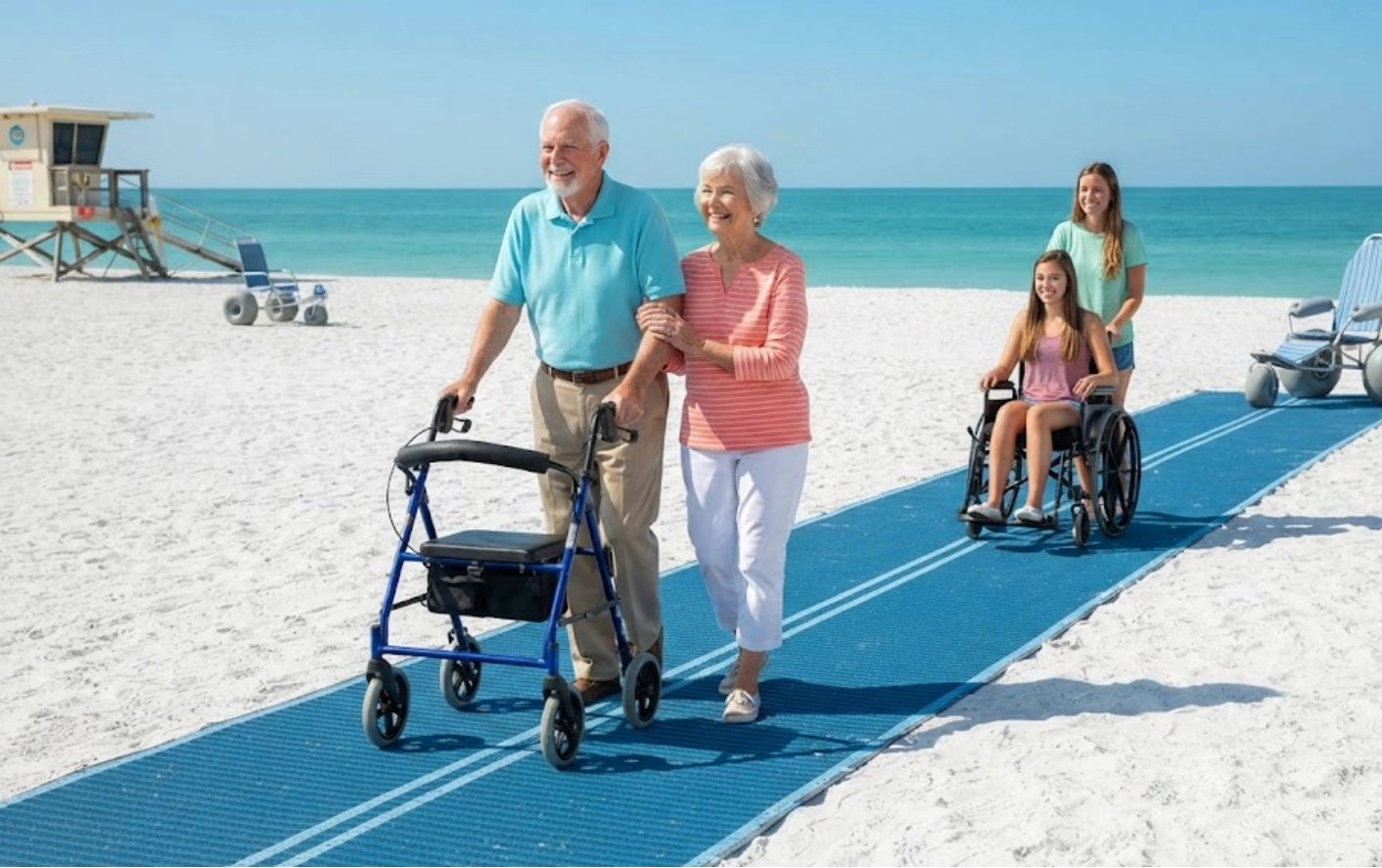
For anyone who navigates the world on wheels, with a rollator, or on joints that treat soft sand as an adversary, the beach has long been travel’s most frustrating paradox, the most relaxing place on earth guarded by its least cooperative surface. That’s why the rise of genuinely accessible beach vacations counts as one of the happiest stories in travel. Roll-out access mats now stripe hundreds of American beaches, balloon-tired beach wheelchairs wait free at lifeguard stands, and a handful of coastal towns have made barrier-free shorelines a point of civic pride. The result is that the beach week is fully back on the table. Here’s where the access is best and how to plan the day around it.
The Infrastructure That Changed Everything
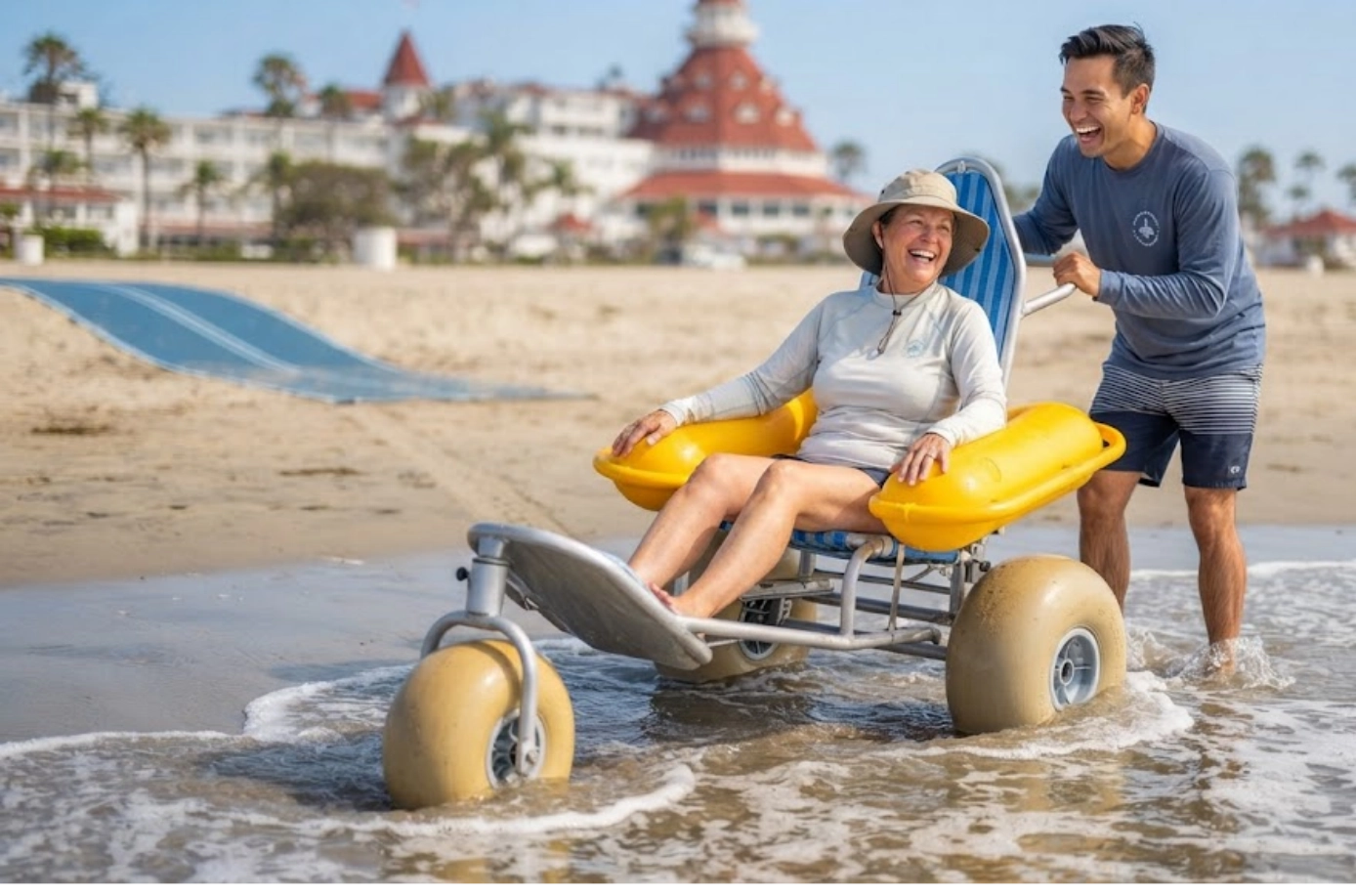
Three pieces of equipment did the heavy lifting. Beach access mats, the firm blue or gray roll-out pathways, carry wheelchairs, scooters, strollers, and unsteady ankles from boardwalk to waterline over sand that would otherwise swallow wheels. Beach wheelchairs, with wide balloon tires that float over soft sand, are now loaned free or rented cheaply at hundreds of coastal parks and towns, and many locations stock floating models with armrest pontoons that go straight into the surf, a development we chronicled in our story on the beach wheelchair movement changing shorelines. And accessible amenities, ramped boardwalks, step-free restrooms and showers, reserved parking close to the sand, complete the chain, because a beach is only as accessible as its least accessible link.
The planning rule that follows: confirm all three links, the route to the sand, the equipment on it, and the facilities behind it, with a call to the specific beach’s parks department, since access mats can be seasonal and beach wheelchairs often work on first-come or reservation systems
Where the Access Is Best
Sarasota and Siesta Key, Florida: Siesta Beach pairs its famously powdery quartz sand, kept cool underfoot, with access mats, free beach wheelchairs, and accessible pavilions, part of why the area anchors so many easy Gulf Coast weeks, as we found in our guide to Sarasota’s best. Arrive before ten for the closest accessible parking and the coolest sand.
Hanauma Bay and Waikiki, Hawaii: Oahu leads the islands with mats and free beach wheelchair loans at several beaches, letting the famous snorkeling bay and gentle Waikiki surf welcome wheels. Reserve equipment ahead in high season, since the loan programs are popular.
Ocean City, Maryland and the Jersey Shore: The Mid-Atlantic boardwalk towns were built for rolling, with miles of flat boardwalk, ramped street ends, mats at multiple beaches, and free wheelchair loans in season at many, Wildwood and Ocean City among the standouts. The boardwalk itself doubles as the evening entertainment, fully step-free from end to end.
San Diego County, California: Mission Beach, Coronado, and Oceanside combine mats, power beach wheelchair loans at select locations, and firm-sand stretches near the waterline, backed by a long flat oceanfront path. The famously mild weather keeps the season open nearly year-round.
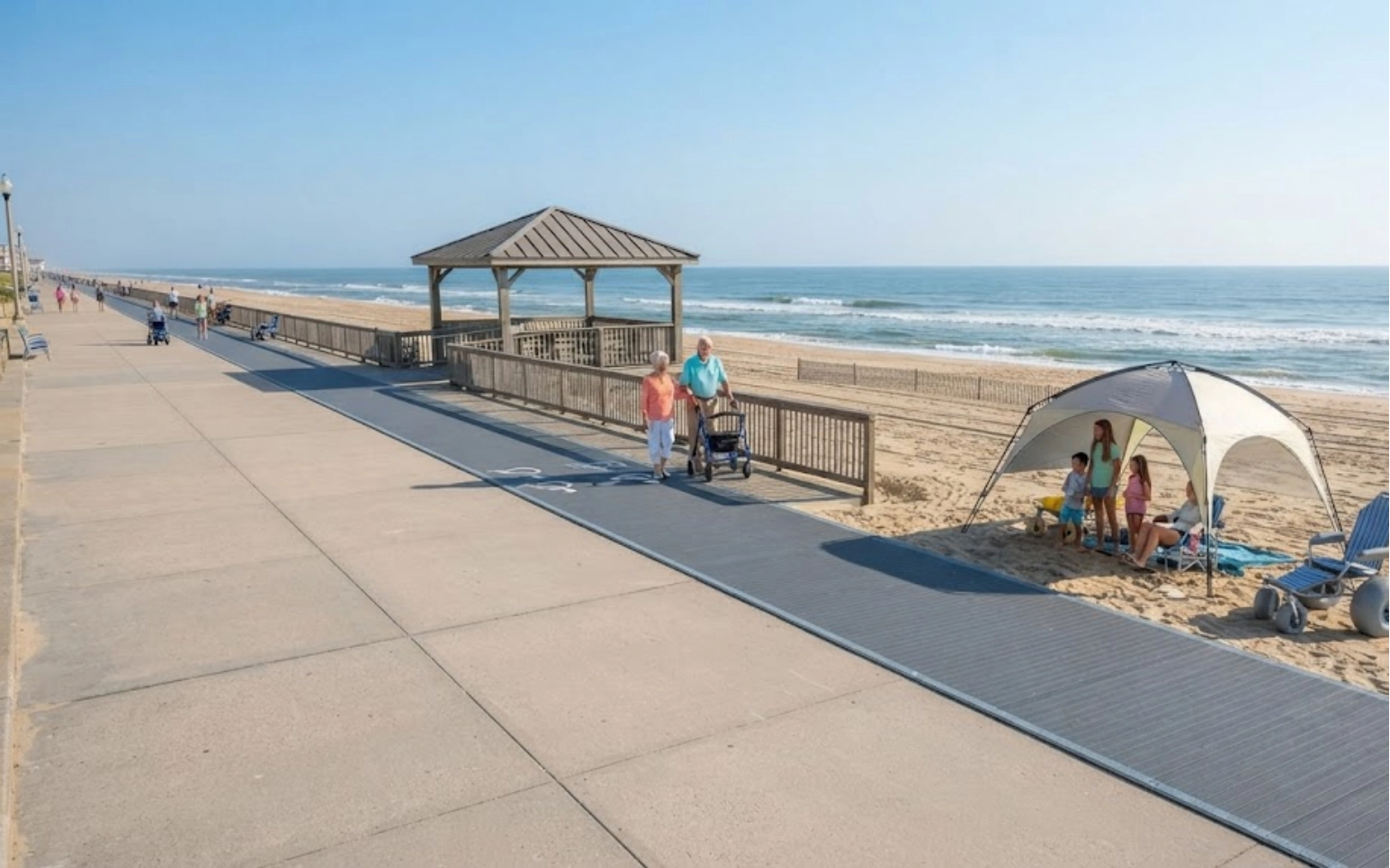
Virginia Beach: A three-mile flat boardwalk with a separate rolling lane, mats at multiple access points, and a well-run beach wheelchair program make it one of the East Coast’s most reliably equipped shores. Summer evenings add free concerts at ramped oceanfront stages.
Planning the Beach Day Itself
A little rhythm turns good infrastructure into a great day. Go morning or late afternoon, when reserved accessible parking is available, the sand is cooler for transfers, and the sun is kinder, and set up adjacent to the mat rather than at its far end, since the mat is your supply line for restrooms, snacks, and shade runs. Reserve the beach wheelchair a day ahead where reservations exist, bring a lightweight pop-up canopy or rent an umbrella setup, since shade is the accessibility feature nobody lists, and pack the transfer-friendly extras: a large towel for seat surfaces, water shoes for the hot-sand gap the mat doesn’t cover, and a dry bag for hearing aids and phones.
Resort travelers should ask specifically whether the property has its own mat, beach wheelchair, and pool lift, all increasingly standard at better beachfront hotels, and cruise travelers can check which port beaches offer equipment through the accessibility resources at WheelchairTravel.org. The National Park Service also lists shoreline access programs at its seashores through the NPS accessibility portal.
Back to the Water
One reader told us about her first floating beach wheelchair ride after twelve years of watching her family swim from the boardwalk: her granddaughter pushed her past the tide line, the pontoons lifted, and she was in the Atlantic again, sixty-one years after her first time in it. The equipment cost the town a few thousand dollars. The moment, she said, didn’t have a price. That’s what this quiet infrastructure revolution is really building, mat by mat, chair by chair: not access to sand, but the way back to the water, for everyone who thought that door had closed.

Written by the
ZestYears Editorial Team