
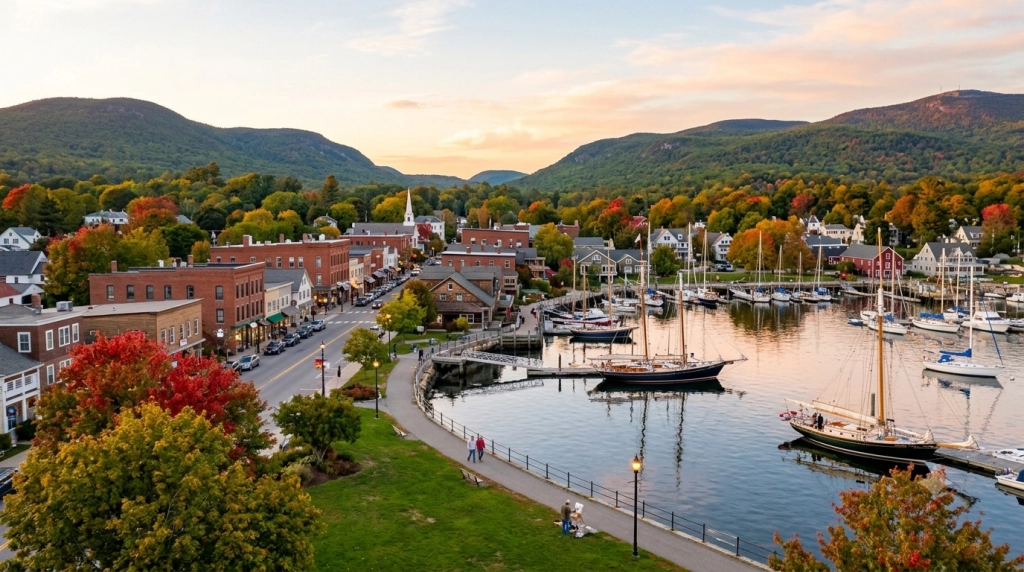
Slow travel hit an all time high in search interest this year, and nowhere does it pay off like small town America. The best small towns in America to visit aren’t the ones you photograph from the car window on a Saturday. They’re the ones where a week’s stay turns the coffee shop owner into someone who knows your order, the farmers market into your grocery store, and a vacation into something closer to a trial run at a different life. Here are the towns that reward settling in, and the simple approach that makes a long stay work.
Why a Week Beats a Weekend
The math of slow travel is friendly. Vacation rentals discount meaningfully for weekly stays, a kitchen cuts restaurant bills in half, and one home base eliminates the packing, driving, and checking in that eat whole days on a multi-stop itinerary. But the better argument is what happens to the trip itself. By day three in a small town you’ve found your walking route. By day five you’re getting restaurant recommendations from the bookstore clerk rather than a review site. Travelers consistently report that the second half of a long stay is when a place opens up, which is exactly the part a weekend visitor never reaches. We’ve made the full case in our piece on why staying longer in one place is the smartest trip you’ll ever plan, and small towns are where the strategy shines brightest.

Towns Built for Lingering
A great long stay town needs a walkable center, enough restaurants that a week doesn’t exhaust them, and day trips in every direction. These five deliver on all counts, each with its own personality.
Beaufort, South Carolina: The Lowcountry’s quiet masterpiece checks every box, with antebellum streets shaded by live oaks, a waterfront park made for evening strolls, and Savannah and Charleston each within a 90 minute drive when you want a city day. Shrimp boats still work the waters, and the porch culture is contagious.
Traverse City, Michigan: The unofficial capital of the Midwest’s most beautiful region anchors a peninsula of cherry orchards, wineries, and the astonishing dunes of Sleeping Bear, which the National Park Service details on its Sleeping Bear Dunes page. A 10 mile bayfront trail begins downtown.
Taos, New Mexico: A thousand years of pueblo history sits under some of the best light in America, which is why artists never leave. Hot springs, the Rio Grande Gorge, and green chile in every direction round out a stay that feels genuinely unlike anywhere else in the country.
Camden, Maine: This is where the mountains genuinely meet the sea. Schooners fill the harbor, Mount Battie’s summit view is a short drive or a satisfying hike, and lobster rolls are a food group. The state’s official Visit Maine site covers the midcoast region in detail.
Helen, Georgia: The Bavarian style mountain town we profiled in our story on Helen, Georgia and why it stole our hearts makes an ideal base for the North Georgia mountains, waterfalls, and a surprisingly good wine trail, with a season for every taste from tubing summers to Oktoberfest. Cabin rentals in the hills above town drop meaningfully for weeklong stays.
How to Choose Your Town
Match the town to your daily rhythm rather than its reputation. If your ideal morning is a long walk, prioritize towns with trail systems or waterfronts, like Camden’s harbor path or Traverse City’s 10 mile bayfront trail. If you’re a reader and museum person, college towns punch far above their weight, offering lectures, performances, and good bookstores in walkable packages. Oxford, Mississippi and Northampton, Massachusetts are both essentially small towns wrapped around cultural engines. Food lovers should look at towns adjacent to agricultural regions, since farm country means farmers markets and chefs who cook what grows nearby. Check the calendar too. Many small towns have a signature festival week when lodging triples in price and quiet disappears, which is either the exact week you want or the exact week to avoid, depending on your taste.

Settling In Like a Temporary Local
A few habits transform a long stay. Shop the farmers market your first morning, because it stocks your kitchen and doubles as an introduction to the town’s characters. Pick one cafe and return daily, since regulars get treated like regulars remarkably fast. Say yes to the community calendar, whether that’s a concert on the green, a library talk, or a church rummage sale, because these are where visitors and locals actually mix. And build in genuinely empty days. The failure mode of any trip is scheduling it like a workweek, and the entire point of a slow stay is the unscheduled Tuesday that turns into your favorite day. One couple we heard from booked a month in Beaufort intending to day trip constantly, and instead spent most afternoons on their rented porch, reading and watching shrimp boats. They described it as the best travel money they ever spent. That’s the small town secret in a sentence: the destination is the pace.

Written by the
ZestYears Editorial Team