

Some days, stress shows up in obvious ways: feeling anxious, overwhelmed, or on edge. Other times, it creeps in more quietly, like a tight chest, a cluttered mind, or trouble falling asleep even when you’re completely worn out. It’s not always the big or dramatic things that wear us down. More often, it’s the steady hum of the everyday: a doctor’s appointment, a tough phone call, or simply trying to keep up when your energy is running low.
If any of that sounds familiar, you’re not alone, and you’re not without tools. One of the simplest ways to quiet your nervous system doesn’t require a prescription, a yoga mat, or a big lifestyle change. It’s a gentle breathing technique called 4-7-8 breathing, and it’s quietly gaining popularity among older adults looking for a natural way to ease tension, rest better, and regain a sense of calm.
What Is 4-7-8 Breathing?
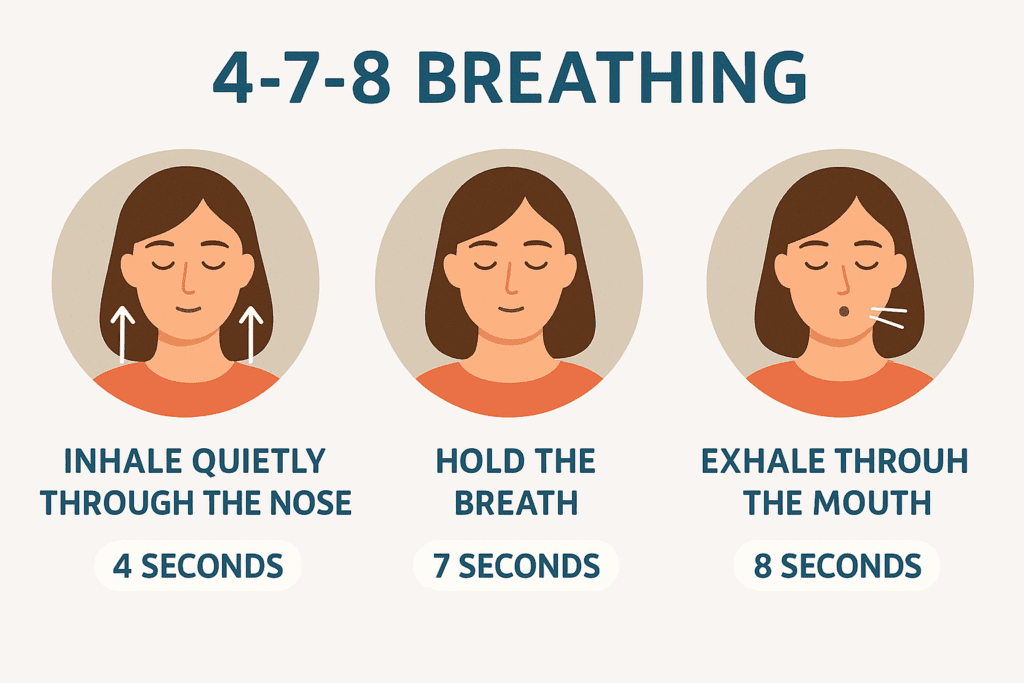
At its core, 4-7-8 breathing is a way of slowing down your breath to help calm the body and mind. The numbers refer to the rhythm: breathe in for four seconds, hold for seven, and exhale for eight.
The method was popularized by Dr. Andrew Weil, a Harvard-trained physician who studied ancient breathing techniques and adapted this one from traditional yogic practices. The idea is that by changing your breath, you send a signal to your nervous system that things are safe, that there’s no emergency, and it’s okay to relax.
It’s that reset that many of us don’t realize we need.
“Sandra M., 67 from St. Paul said she began using 4-7-8 breathing when she kept waking up at 3 a.m. with her mind racing. It might sound simple, but after just a few nights of trying it, she was falling back asleep within minutes.”
How to Get Started
You don’t need to sit cross-legged or chant anything. Most people try this in bed before sleep or in a quiet chair during the day. Just close your eyes if it feels right, take a deep breath in through your nose for four counts, gently hold it for seven, and exhale through your mouth for eight. Do that three or four times in a row.
That’s it. Nothing fancy. Just you, your breath, and a little bit of quiet.
Some people feel a little lightheaded at first, that’s normal and usually fades quickly. It’s okay to build up slowly and shorten the counts if needed.

Why It Helps
As we get older, our bodies don’t always recover from stress as easily as they once did. That’s where breathwork can help. Slowing your breathing sends a message to your nervous system that it’s safe to relax, shifting you out of fight-or-flight mode and into a calmer, more balanced state. It’s not a cure-all, but it offers a gentle sense of control and sometimes, that’s enough to make a real difference.
“My blood pressure tends to spike when I’m stressed said Darryl J., 73 from Charlotte, NC. A friend told me about this technique. I started doing it before doctor visits and after phone calls that upset me. It’s not magic, but it helps me feel like I can catch up to myself.”
You don’t have to master this overnight. Like any new habit, it takes a little time to get used to, but it’s one of those things that’s easy to come back to. Some people use it daily; others just keep it in their back pocket for when life gets heavy.
Try it tonight. And if it helps, pass it along.

Written by the ZestYears Editorial Team
This article is for informational purposes only and does not replace professional medical advice. Consult a qualified healthcare provider with any health concerns.